
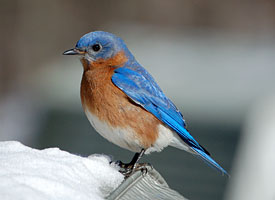
 Bluebirds are one of the most beautiful and desired backyard birds. Even though the population has greatly decreased, the future can still be promising for them. The most important step we can take to help bring back the bluebird is to provide nesting sites by setting out a bluebird box or starting a bluebird trail. Nesting boxes should be left up year-round for roosting birds.
Bluebirds will seldom visit a regular feeder, but you will increase your changes of attracting bluebirds if you offer them mealworms to eat. There are specific mealworm feeders and they will learn what time you typically dole out their daily portion and be ready to eat as soon as you leave the feeder. They will also eat suet.
Eastern Bluebirds
Most of the country drives during an eastern North American summer will turn up a few Eastern Bluebirds sitting on telephone wires or perched atop a nest box, calling out in a short, wavering voice or abruptly dropping to the ground after an insect. Marvelous birds to capture in your binoculars, male Eastern Bluebirds are a brilliant royal blue on the back and head, and warm red-brown on the breast. Blue tinges in the wings and tail give the grayer females an elegant look.
Western Bluebirds
In open parklands of the American West, brilliant blue-and-rust Western Bluebirds sit on low perches and swoop lightly to the ground to catch insects. Deep blue, rusty, and white, males are considerably brighter than the gray-brown, blue-tinged females. This small thrush nests in holes in trees or nest boxes and often gathers in small flocks to feed on insects or berries, giving their quiet, chortling calls. You can help out Western Bluebirds by placing nest boxes in your yard or park.
Mountain Bluebirds
A common sight in ranchland and other open areas of the American West, the male Mountain Bluebird is a breathtaking brilliant sky blue. It prefers more open habitats than the other bluebirds and can be found in colder habitats in winter.
Thank you to The Macaulay Library at the Cornell Lab of Ornithology, Ithaca, New York.
